Mastering Ultrasound Guided Regional Anesthesia Blocks has revolutionized perioperative acute pain management.
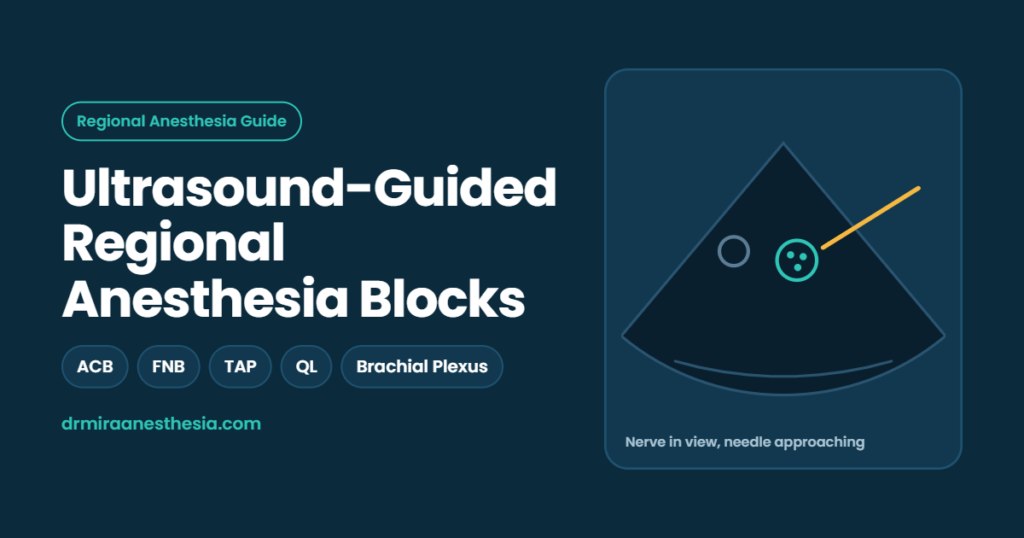
Ultrasound-guided regional anesthesia (UGRA) has revolutionized perioperative acute pain management. Using real-time ultrasound imaging allows anesthesiologists to visualize neural structures, target needle trajectories accurately, and monitor local anesthetic spread, significantly reducing the risk of local anesthetic systemic toxicity (LAST) and vascular puncture.
For anesthesiology residents and clinical practitioners, mastering core nerve blocks provides superior postoperative analgesia, reduces opioid consumption, and improves patient satisfaction.
Here are the 5 essential ultrasound-guided regional nerve blocks every anesthesia resident should master.
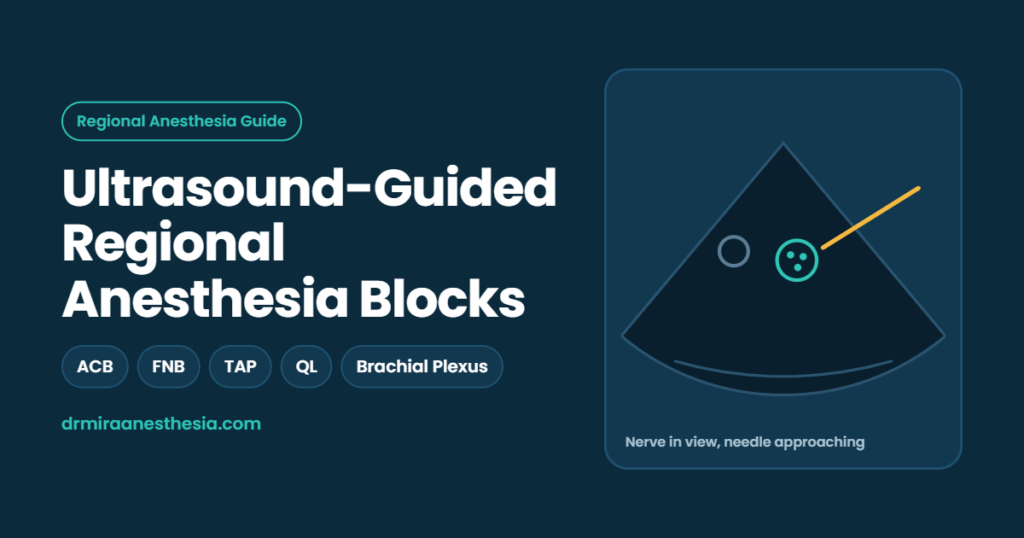
Ultrasound guided regional anesthesia (UGRA) has revolutionized perioperative acute pain management.
1. Why Master Ultrasound-Guided Regional Anesthesia Blocks?
Ultrasound guided regional anesthesia (UGRA) has revolutionized perioperative acute pain management
Adductor Canal Block (ACB)
Table of Contents
Primary Indication: Total Knee Arthroplasty (TKA), ACL reconstruction, and anterior knee procedures.
The Adductor Canal Block is a sensory-predominant block targeting the saphenous nerve and the nerve to the vastus medialis within the adductor canal in the mid-thigh.
- Why It’s Essential: Unlike a traditional femoral nerve block, the ACB provides effective analgesia for knee surgery while preserving quadriceps motor strength, facilitating early postoperative mobilization and physical therapy.
- Sonoanatomy Landmarks: Femoral artery beneath the sartorius muscle, bordered medially by the adductor longus/magnus and laterally by the vastus medialis.
👉 Check Hadzic’s Regional Anesthesia Textbook on Amazon
2. Femoral Nerve Block (FNB)
Primary Indication: Femoral shaft fractures, patellar surgery, and anterior thigh procedures.
The Femoral Nerve Block provides dense analgesia to the anterior thigh, femur, and knee joint by targeting the anterior division of the lumbar plexus (L2-L4).
- Why It’s Essential: It is one of the most reliable and easiest peripheral nerve blocks to learn in emergency and elective surgical settings.
- Sonoanatomy Landmarks: Located lateral to the femoral artery and anterior to the iliopsoas muscle, underneath the fascia lata and fascia iliaca.
3. Transversus Abdominis Plane (TAP) Block
Primary Indication: Lower abdominal surgeries, including Cesarean sections, laparoscopic appendectomies, and hernia repairs.
The TAP block deposits local anesthetic into the neurovascular plane between the internal oblique and transversus abdominis muscles, blocking the anterior rami of the thoracolumbar nerves (T7-L1).
- Why It’s Essential: It offers excellent somatic analgesia for anterior abdominal wall incisions, dramatically decreasing postoperative parenteral opioid requirements.
- Sonoanatomy Landmarks: Three distinct muscle layers on the anterolateral abdominal wall: External Oblique, Internal Oblique, and Transversus Abdominis.
4. Quadratus Lumborum (QL) Block
Primary Indication: Abdominal, gynecological, urological, and hip surgeries.
The Quadratus Lumborum block is an advanced posterior abdominal wall block where local anesthetic spreads along the thoracolumbar fascia to reach the paravertebral space, providing both somatic and visceral analgesia.
- Why It’s Essential: It provides broader thoracic dermatomal coverage ($T7-L1/L2$) and superior visceral analgesia compared to a standard TAP block.
- Sonoanatomy Landmarks: Quadratus lumborum muscle lateral to the psoas major and anterior to the erector spinae muscle, with visualization of the lumbar transverse process.
👉 Explore Clinical Anesthesia Reference Textbooks on Routledge
5. Brachial Plexus Block (Interscalene / Axillary)
Primary Indication: Upper extremity procedures (Shoulder, Arm, Forearm, and Hand surgeries).
Mastering brachial plexus block approaches is fundamental for upper limb anesthesia:
- Interscalene Approach: Targets roots/trunks (C5-C7) for shoulder and clavicle procedures.
- Axillary Approach: Targets individual terminal nerves (Median, Ulnar, Radial) for forearm and hand surgeries.
- Why It’s Essential: Provides complete surgical anesthesia and long-lasting postoperative pain relief, often allowing upper limb surgeries to be performed under regional anesthesia alone.
Safety Checklist for UGRA Practice
Before every block, run through this safety checklist for ultrasound guided regional anesthesia.
- Aseptic Technique: Maintain strict sterile conditions with ultrasound probe covers and sterile gel.
- Needle Tip Visualization: Always visualize the needle tip in-plane before injecting local anesthetic.
- Aspiration & Test Dose: Aspire every $3-5 \text{ mL}$ to rule out intravascular placement.
- LAST Preparedness: Keep 20% Lipid Emulsion Therapy readily accessible in the operating room.
Consistent practice is the key to mastering ultrasound guided regional anesthesia.