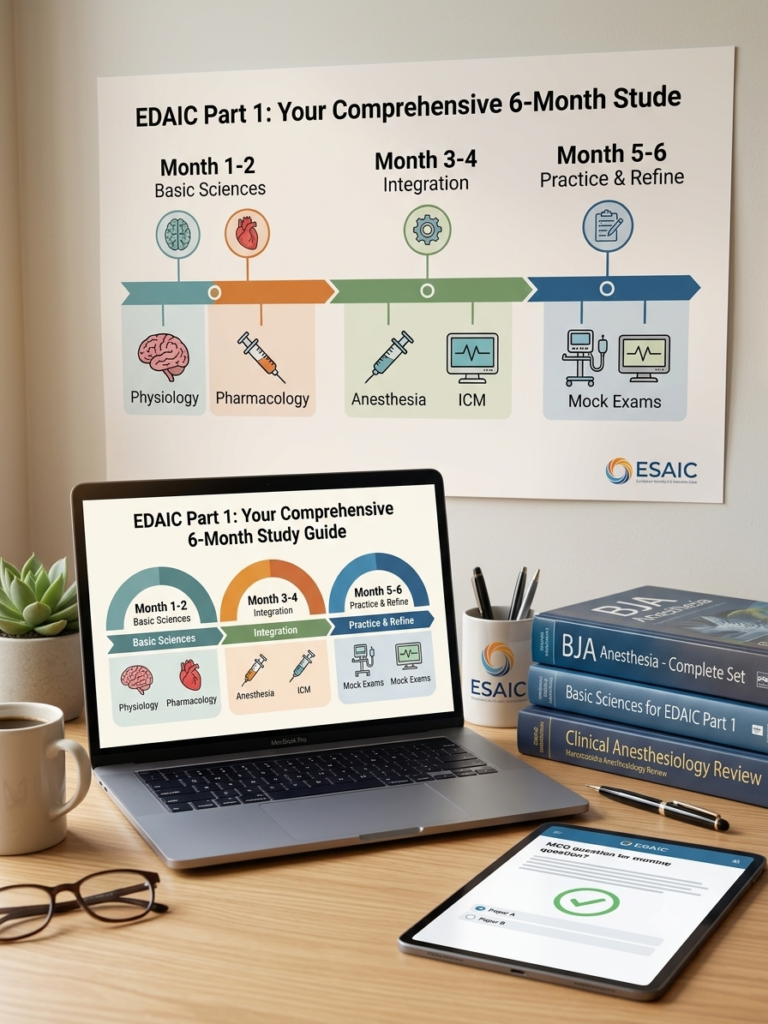
EDAIC Part 1 preparation requires more than simply reading one large anaesthesia textbook. A focused combination of exam-specific practice and reliable reference books can make revision much more efficient
Preparing for the European Diploma in Anaesthesiology and Intensive Care (EDAIC) Part 1 requires more than simply reading one large anaesthesia textbook. A focused combination of exam-specific practice and reliable reference books can make revision much more efficient.
EDAIC Part I consists of Paper A and Paper B. Paper A focuses mainly on basic sciences, while Paper B covers areas including internal medicine, emergency medicine, general anaesthesia, regional anaesthesia, special anaesthesia, pain and intensive care medicine.
If you are preparing for EDAIC Part 1 in 2026, these are some of the most useful books to consider.
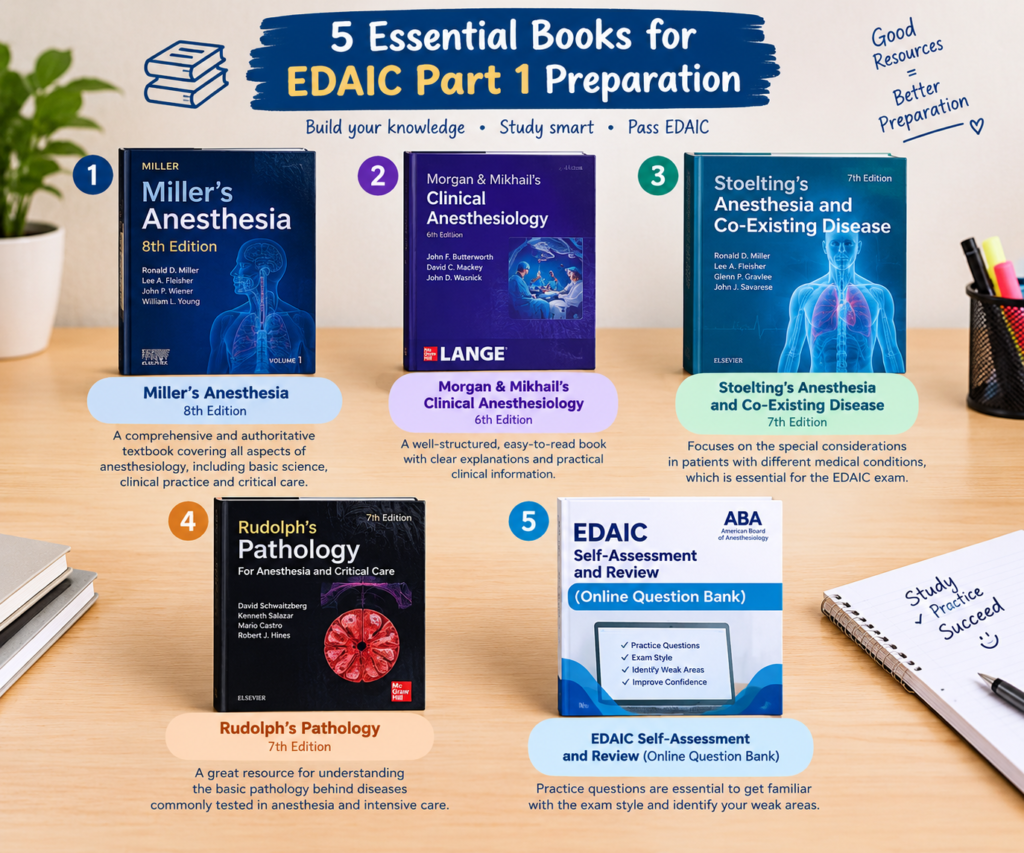
For effective EDAIC Part 1 preparation, combine these books with regular practice questions and revision.
1. How to Pass the EDAIC
Table of Contents
Best for: EDAIC-specific exam practice
If you want one book specifically designed around the EDAIC examination, this is the book I would put first on the list.
How to Pass the EDAIC was published by Oxford University Press in 2023. It covers both Part I and Part II and includes dedicated sections for Paper A and Paper B. The Part I section contains practice questions and model answers covering subjects such as physiology, pharmacology, anatomy, physics, statistics and clinical anaesthesia.
Why it is useful
- Specifically written for EDAIC preparation
- Includes Paper A practice
- Includes Paper B practice
- Provides model answers and explanations
- Useful for learning the style of EDAIC questions
- Helps identify weak areas during revision
Best choice if you want: an exam-focused book rather than another general anaesthesia textbook.
👉 [Check the current Amazon price and availability]
I
2. Oxford Handbook of Anaesthesia, 5th Edition
Best for: Clinical anaesthesia and quick revision
The Oxford Handbook of Anaesthesia, 5th Edition is a practical reference covering a broad range of anaesthetic practice. The fifth edition was published by Oxford University Press in 2021/2022 and includes topics ranging from preoperative assessment and cardiovascular and respiratory disease to regional anaesthesia, airway management, analgesia and emergencies.
It is particularly useful when you need a concise clinical reference rather than a very large textbook.
Why it is useful for EDAIC preparation
- Broad clinical coverage
- Useful for Paper B topics
- Practical and relatively easy to navigate
- Helpful for reviewing clinical concepts after studying from a larger textbook
- Useful beyond the EDAIC examination during anaesthesia training
👉 [Check the current Amazon price and availability]
3. Principles of Physiology for the Anaesthetist
Best for: Physiology and Paper A
Physiology is an important component of the basic sciences required for anaesthesia examinations. A dedicated anaesthesia physiology textbook can therefore be useful when you need to understand mechanisms rather than simply memorize facts.
Principles of Physiology for the Anaesthetist focuses on physiological concepts relevant to anaesthetic practice, making it particularly useful for candidates reviewing cardiovascular, respiratory and renal physiology.
Why it is useful
- Anaesthesia-focused physiology
- Helps connect basic physiology with clinical practice
- Useful for Paper A revision
- Good reference when an exam question requires understanding rather than memorization
👉 [Check the current Amazon price and availability]
4. Pharmacology for Anaesthesia and Intensive Care
Best for: Pharmacology
Pharmacology is another important part of the basic science preparation for EDAIC Part I.
Pharmacology for Anaesthesia and Intensive Care provides an anaesthesia-specific approach to pharmacology and is useful for reviewing mechanisms of action, pharmacokinetics, pharmacodynamics and clinically relevant anaesthetic drugs.
Why it is useful
- Focuses specifically on anaesthesia and intensive care
- Useful for Paper A
- Helps connect pharmacology with clinical anaesthetic practice
- Useful for reviewing drug mechanisms and effects
👉 [Check the current Amazon price and availability]
Insert your Amazon Associates affiliate link here.
5. Miller’s Anesthesia
Best for: Comprehensive anaesthesia reference
If you want a comprehensive reference textbook rather than an exam-only resource, Miller’s Anesthesia is one of the major textbooks used in anaesthesia.
It is much more extensive than what you need for a first-pass EDAIC revision. Therefore, I would not recommend trying to read the entire book specifically for EDAIC Part 1.
Instead, use it selectively when you need deeper explanations of difficult anaesthesia topics.
Why it can be useful
- Comprehensive coverage
- Excellent for deeper understanding
- Useful as a long-term anaesthesia reference
- Helpful when another resource does not explain a difficult topic sufficiently
Best Books for EDAIC Part 1 Preparation
You do not need to read all five books from cover to cover.
A practical approach is:
| Purpose | Recommended resource |
|---|---|
| EDAIC-specific questions | How to Pass the EDAIC |
| Paper A – Physiology | Principles of Physiology for the Anaesthetist |
| Paper A – Pharmacology | Pharmacology for Anaesthesia and Intensive Care |
| Paper B – Clinical review | Oxford Handbook of Anaesthesia |
| Difficult/deeper topics | Miller’s Anesthesia |
A Simple EDAIC Part 1 Study Strategy
Start with your main reference book, then use How to Pass the EDAIC for question practice.
For example:
Study topic → Read/understand → Practice EDAIC questions → Review mistakes → Repeat
This is more efficient than trying to memorize several textbooks simultaneously.
The EDAIC multiple-choice format uses multiple true/false questions, so practicing the specific question style is important.
Final Thoughts
The best EDAIC Part 1 preparation strategy is not about collecting as many textbooks as possible. It is about choosing a small number of reliable resources and using them consistently.
For most candidates, I would prioritize:
1. How to Pass the EDAIC
2. One strong basic-science reference
3. One practical clinical anaesthesia reference
Then use larger textbooks such as Miller’s selectively when you need more detailed explanations.
Good preparation is not about reading everything. It is about knowing what to read, practicing questions, and identifying your weak areas earl